
Best SEO tools used For bloggers 2026: 10 Tools for UK & USA
Running a blog in 2025 is very different from simply publishing an article and waiting for Google traffic. Competition is higher, search behaviour is changing, and bloggers need to understand what people are actually searching for before spending hours writing content.
That is where SEO tools can make a big difference.
The best SEO tools used by bloggers in the UK in 2025 can help with keyword research, competitor analysis, technical SEO, content optimisation, backlinks and search performance. Many of the same platforms are also useful for bloggers targeting readers in the USA, Canada and Australia.
But there is one mistake beginners often make: buying several expensive SEO subscriptions without knowing what they actually need.
This guide takes a practical approach and explains which SEO tools are worth considering, what each one is good at, and which tools make the most sense for different types of bloggers.
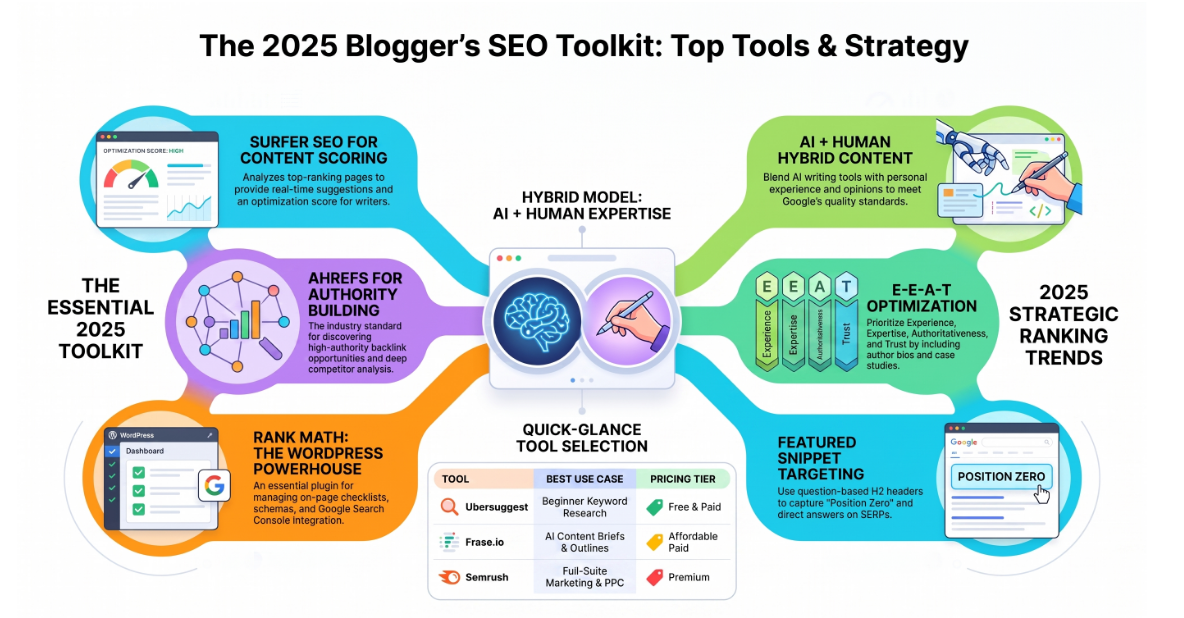
Best SEO Tools for Bloggers 2026
Here are our top picks:
- Google Search Console
- Semrush
- Ahrefs
- Google Trends
- Ubersuggest
- Surfer
- Rank Math
- Screaming Frog SEO Spider
- Google Keyword Planner
- AnswerThePublic
You don’t need all ten.
For a new blog, starting with two or three tools can be more useful than paying for an entire collection of SEO software.
1. Google Search Console – Best Free Tool for Every Blogger
If you have a website and want traffic from Google, Google Search Console should be one of your first SEO tools.
It is Google’s own platform for understanding how your website performs in Google Search.
You can use Search Console to see:
- Which search queries bring impressions
- Which queries generate clicks
- Which pages receive organic traffic
- Your average search position
- Search performance trends
- Indexing-related information
Google’s documentation specifically describes Search Console as a tool that helps website owners understand how their sites perform in Google Search.
Google also introduced a new Search Console Insights experience in 2025, bringing insights into the main Search Console interface and making it easier for creators to identify popular pages and trending queries.
Why bloggers should use it
Imagine one of your articles is appearing for 20 different search queries, but you only knew about the main keyword.
Search Console can reveal those additional queries.
Those queries can become:
- New blog posts
- New H2 sections
- FAQ questions
- Internal links
- Content refresh ideas
Best for: Every blogger
Price: Free
2. Semrush – Best All-in-One SEO Platform
Semrush is designed for bloggers and marketers who want to go deeper into SEO research.
Instead of using separate tools for every task, Semrush brings together several SEO and marketing functions.
You can use it for:
- Keyword research
- Competitor analysis
- Rank tracking
- Website audits
- Content research
- Keyword gap analysis
For a blogger targeting the UK, you can research the UK search market and compare your website with competitors that are already receiving organic traffic.
The same approach can be used when targeting the USA.
Who should use Semrush?
Semrush makes the most sense when your blog is becoming a serious business rather than a small experiment.
Best for: Professional bloggers, affiliate marketers and growing websites
Price: Paid plans
3. Ahrefs – Best for Competitor & Backlink Research
Ahrefs is particularly useful when you want to understand why competing websites are ranking.
One of its strongest use cases is competitor and backlink research.
You can investigate:
- Competitor pages
- Ranking keywords
- Backlinks
- Top-performing content
- Content gaps
- Organic search opportunities
For example, suppose a UK competitor ranks for 500 keywords related to your niche.
Instead of randomly choosing your next topic, you can study those keywords and identify relevant opportunities that your website has not covered.
Ahrefs is also frequently recognised among leading SEO platforms in UK-focused software comparisons.
Best for: Competitor research, backlinks and advanced SEO
Price: Paid
4. Google Trends – Best for Trending Topics
Keyword volume isn’t everything.
Sometimes you want to know whether interest in a topic is increasing, falling or seasonal.
That’s where Google Trends becomes useful.
For example, imagine you want to write about a new technology product.
Instead of immediately creating ten articles around it, check whether search interest is actually growing.
You can also compare search interest between countries.
This is especially useful if you target both:
UK + USA
A topic that is popular in the United States may have significantly lower interest in the UK.
Bloggers can use Google Trends to:
- Find emerging topics
- Compare keywords
- Identify seasonal searches
- Research country-specific interest
- Decide when to publish content
Best for: Topic research and trend discovery
Price: Free
5. Ubersuggest – Best for Beginner Bloggers
If you are new to SEO, you probably don’t need an extremely complicated platform.
Ubersuggest is a relatively beginner-friendly option for discovering keyword ideas and researching competitors.
It can help you find:
- Keyword suggestions
- Related topics
- Search difficulty information
- Competitor content
- Content ideas
Its simple interface makes it useful for bloggers who are still learning how SEO research works.
When should you choose Ubersuggest?
Choose it if you want to learn keyword research without immediately committing to a more advanced SEO platform.
Best for: Beginners and smaller blogs
Price: Free and paid options
6. Surfer – Best for Content Optimisation
Finding a keyword is only the beginning.
You still need to create an article that covers the topic properly.
Surfer focuses heavily on content optimisation and can help you analyse search results and improve the structure of an article around a target keyword.
It can be useful for:
- Content briefs
- On-page optimisation
- Related terms
- Content structure
- Existing article optimisation
For example, if you’re targeting:
best SEO tools for bloggers
you can use content optimisation software to identify related concepts that readers may expect to see in a comprehensive article.
Important SEO tip
Don’t treat an optimisation score as a ranking guarantee.
A high content score doesn’t automatically mean Google will rank the article.
The content still needs to be useful, original and aligned with search intent.
Best for: Content writers and affiliate bloggers
Price: Paid
7. Rank Math – Best SEO Plugin for WordPress
If your blog uses WordPress, Rank Math can become part of your everyday SEO workflow.
Instead of opening a separate SEO platform every time you publish an article, you can manage many important optimisation tasks directly inside WordPress.
Depending on the setup, you can use it for:
- SEO titles
- Meta descriptions
- Schema markup
- XML sitemaps
- Redirections
- Focus keywords
- On-page optimisation
Rank Math vs Yoast SEO
Both are popular WordPress SEO plugins.
You don’t need to install both.
If you’re already using Yoast SEO, there is no reason to switch simply because another blogger recommends Rank Math.
Your time is better spent improving content, internal links, technical SEO and search intent.
Best for: WordPress bloggers
Price: Free and paid versions
8. Screaming Frog SEO Spider – Best for Technical SEO
A beautiful article cannot compensate for a website filled with technical problems.
Screaming Frog SEO Spider is a desktop crawler that can help you investigate technical SEO issues across your website.
It can help identify things such as:
- Broken links
- Missing title tags
- Missing meta descriptions
- Redirect problems
- Duplicate content signals
- Crawl-related issues
It becomes especially useful as a website grows.
A blog with 20 pages may not need frequent technical crawling.
A website with hundreds or thousands of URLs is a different story.
Best for: Technical SEO and larger websites
Price: Free version available with paid options
9. Google Keyword Planner – Best Free Keyword Research Tool
Google Keyword Planner is primarily associated with Google Ads, but bloggers can still find it useful for keyword discovery.
You can use it to explore keyword ideas and investigate search demand.
One particularly useful feature for international bloggers is geographic targeting.
If you’re targeting:
- United Kingdom
- United States
- Canada
- Australia
you can research these markets separately instead of treating all English-language searches as one audience.
Example
A blogger targeting the UK might research:
best broadband deals UK
while a US-focused website might target:
best internet providers USA
The search intent is similar, but the market is completely different.
Best for: Keyword discovery and geographic research
Price: Free with Google Ads access
10. AnswerThePublic – Best for Finding Questions
Sometimes the hardest part of blogging is not writing.
It’s finding what people actually want to know.
AnswerThePublic can help uncover questions and related searches around a topic.
For example, if your main topic is SEO tools, you might discover questions around:
- Which SEO tool is best for beginners?
- Are SEO tools worth paying for?
- What is the best free SEO tool?
- Which SEO tool is best for keyword research?
- How do SEO tools work?
These questions can become separate articles or useful FAQ sections.
Best for: Long-tail keywords and content ideas
Price: Free and paid options
Best SEO Tools for UK Bloggers: My Recommended Stack
You don’t need ten subscriptions to run a successful blog.
Here is a simpler way to choose.
For a beginner blogger
Google Search Console + Google Trends + Yoast SEO
This gives you a strong free foundation.
For an affiliate blogger
Semrush or Ahrefs + Google Search Console + Yoast SEO
This combination gives you better competitor and keyword research.
For a content-heavy blog
Surfer + Google Search Console + Yoast SEO
This focuses more heavily on content optimisation and performance monitoring.
For a technical SEO project
Screaming Frog + Google Search Console + Semrush
This combination can help you investigate both technical problems and search visibility.
Best SEO Tools for USA Bloggers
Although this article focuses on UK bloggers, most of these tools work equally well for websites targeting the United States.
The important thing is country-specific research.
Don’t assume that a keyword popular in Britain will have the same:
- Search volume
- Competition
- Search intent
- Commercial value
in the United States.
For US-focused blogs, use tools such as Semrush, Ahrefs, Google Keyword Planner and Google Trends to investigate the American search market before creating large content clusters.
Best Free SEO Tools for Bloggers
If you’re on a tight budget, start with free tools.
My free SEO stack:
1. Google Search Console
Monitor your actual Google search performance.
2. Google Trends
Find trends and compare topics.
3. Google Keyword Planner
Research keyword ideas.
4. Yoast SEO
Handle basic on-page SEO inside WordPress.
5. Screaming Frog Free
Check smaller websites for technical problems.
This setup can take a new blogger surprisingly far before a paid SEO subscription becomes necessary.
Google also recommends Search Console as part of the process for monitoring and understanding search performance.
How to Use SEO Tools Without Over-Optimising Your Blog
This is where many beginners go wrong.
They discover a keyword and then repeat it everywhere.
That’s not a good SEO strategy.
Instead, use your SEO tools to understand the topic behind the keyword.
For example, if your target keyword is:
best massage chair in India
your article might naturally discuss:
- Massage chair price
- Full-body massage
- Zero gravity
- 3D massage
- 4D massage
- Heat therapy
- Foot massage
- Warranty
- Buying considerations
You aren’t trying to force every phrase into the article.
You’re creating a useful resource around the subject.
That is a much better approach than keyword stuffing.
SEO Workflow for Bloggers in 2025
Here’s a simple workflow you can repeat for almost every article.
Step 1: Find the topic
Use Google Trends, Search Console or keyword research software.
Step 2: Understand the search intent
Search your target phrase on Google.
Look at what type of content is ranking.
Step 3: Research competitors
Use Ahrefs, Semrush or Ubersuggest to understand competing pages.
Step 4: Build a better outline
Cover the questions and subtopics that genuinely matter to the reader.
Step 5: Write the article
Focus on usefulness first and optimisation second.
Step 6: Optimise the page
Use Yoast SEO to review:
- SEO title
- Meta description
- Focus keyphrase
- Internal links
- Image alt text
- Readability
Step 7: Publish and monitor
After publishing, monitor Search Console.
Look for:
Impressions → Queries → Clicks → CTR → Position
If an article receives impressions but few clicks, your title or snippet may need improvement.
If it ranks for unexpected queries, those queries can reveal opportunities for additional content.
Google’s Search Console reporting specifically provides information about impressions, clicks and queries, making it valuable for this type of ongoing optimisation.
Do Bloggers Really Need Paid SEO Tools?
Not always.
If you’re just starting your first blog, spending a large amount every month on SEO software may not be necessary.
Start with free tools and learn how search works.
Once your website begins receiving consistent organic traffic, paid tools become more valuable because you can use their deeper competitor, keyword and backlink data.
The important question isn’t:
“Which SEO tool is the most powerful?”
The better question is:
“Which SEO data do I actually need to make my next blogging decision?”
That mindset can save a lot of money.
Final Verdict: Which SEO Tool Should Bloggers Choose?
The best SEO tools used by bloggers in the UK in 2025 cover different parts of the SEO process.
If you want one tool that every blogger should have, start with Google Search Console.
For advanced competitor and keyword research, consider Semrush or Ahrefs.
For finding trending topics, use Google Trends.
For beginners who want straightforward keyword research, Ubersuggest is worth considering.
For content optimisation, Surfer can be useful.
And if you’re running WordPress, Yoast SEO or Rank Math can handle your everyday on-page SEO requirements.
You don’t need to use every tool.
The strongest SEO workflow is usually a small collection of tools used consistently:
Research → Create → Optimise → Publish → Measure → Improve
That process matters more than having the biggest SEO software budget.
For bloggers targeting the UK, USA, Canada or Australia, the same principle applies: understand the audience, research the local search market, create genuinely useful content and use SEO data to improve what you publish.
That’s how SEO tools become useful—not by replacing good blogging, but by helping you make better decisions.
Frequently Asked Questions
What is the best SEO tool for bloggers in the UK?
There isn’t one perfect tool for every blogger. Google Search Console is the best starting point because it provides data about your own website’s performance in Google Search. For advanced research, Semrush and Ahrefs are strong choices.
What is the best free SEO tool for bloggers?
Google Search Console is one of the most useful free SEO tools because it provides information about your site’s actual Google Search performance.
Is Semrush better than Ahrefs for bloggers?
Both platforms are powerful. Semrush is particularly useful as a broad SEO and marketing platform, while Ahrefs is especially strong for competitor, keyword and backlink research. The better choice depends on your workflow.
Are SEO tools necessary for blogging?
You can start a blog without paid SEO software. However, SEO tools can make keyword research, competitor analysis, technical checks and performance monitoring much easier.
Which SEO tools are best for USA bloggers?
Semrush, Ahrefs, Google Keyword Planner, Google Trends and Google Search Console are useful options for bloggers targeting the US market. Always configure your research around the United States rather than relying only on global data.
Can I use Yoast SEO instead of Rank Math?
Yes. You don’t need both plugins. If Yoast SEO already meets your WordPress SEO requirements, focus on creating useful content and improving your site’s overall SEO rather than changing plugins unnecessarily.